Article
09/12/2025

Matthias Beckman
Creative Director
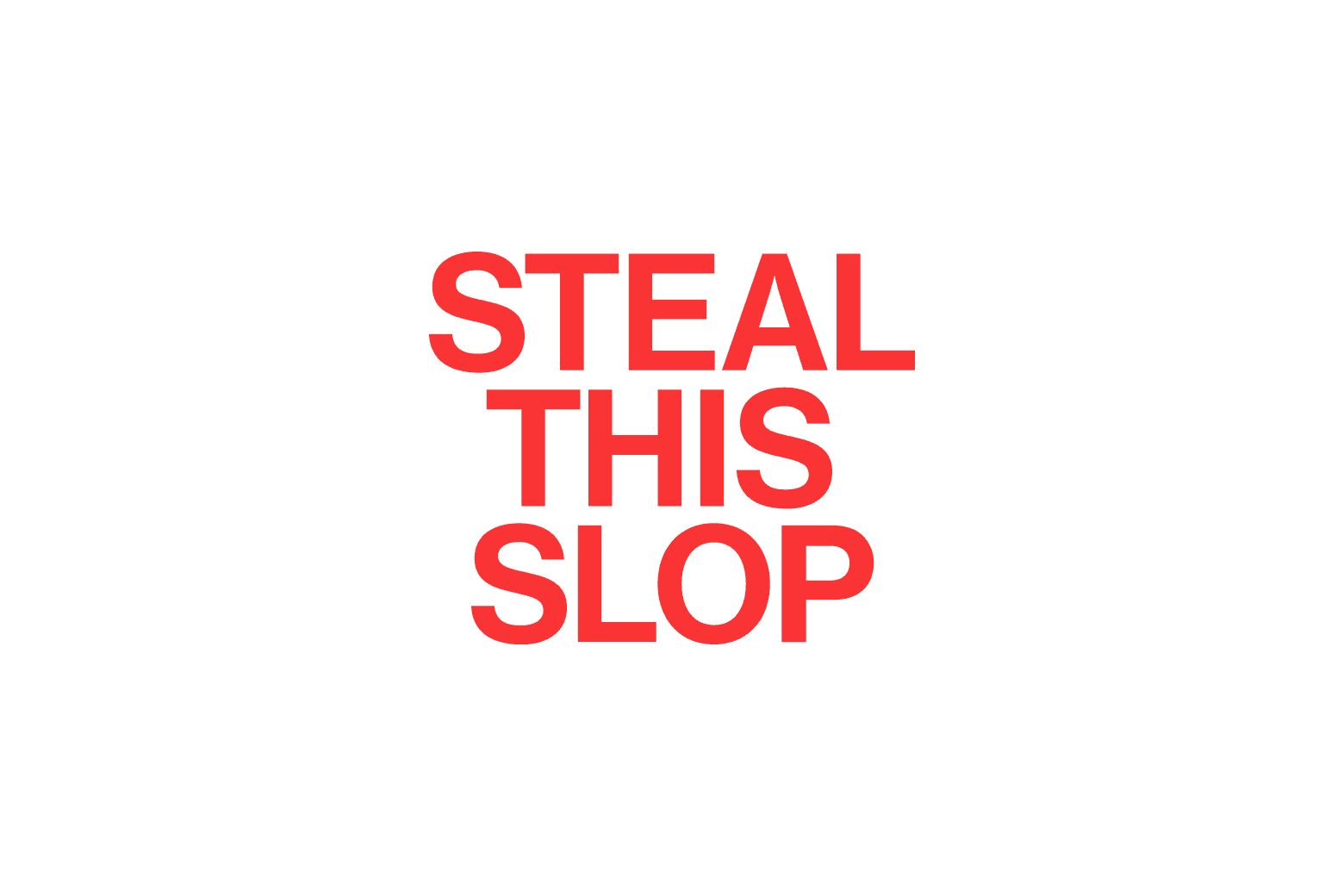
Slop.
When the world shifts, it shows up in the language.
“Spam” appeared when inboxes exploded.
“Clickbait” when short-term attention became a business model.
Now: slop.
Merriam-Webster has noted how quickly the word has spread. Wikipedia now has its own entry for “AI slop”. The The Times writes about companies hiring storytellers to “cut through the AI slop”. At the same time, Satya Nadella, CEO of Microsoft, has pushed back against the term and urged people to stop using it.
The response?
“Microslop.”
It is always interesting when power dislikes a word.
Words appear when something begins to rub collectively. When many people feel the same thing but lack the language for it. Slop is one of those words. But “AI slop” is a misleading label. This is not about technology.
It is about cost.
Companies compete by differentiating themselves. Not only through what they do, but through the signals they send. Every website, touchpoint, piece of content, tone of voice and visual world is ultimately a signal of priorities — what matters to us. That is how markets read organizations.
For a long time, those signals were expensive to produce. It required capital, skill and time to create something coherent. That created real advantage. The companies that invested in structure and clarity built barriers others could not easily cross.
Now expression can be produced at a speed and scale that would have been unthinkable just a few years ago.
And when expression becomes cheap, inflation follows.
Inflation erodes meaning.
Slop is not an aesthetic problem.
It is an economic one.
It appears when it becomes possible to signal meaning without changing the reality behind it.
We notice it.
We feel it.
And we call it slop.
Whenever something becomes easy, it stops being an advantage.
First it was distribution. Then production. On the internet it became experience. The companies that made things simpler, faster and more frictionless won.
Now that it costs almost nothing to appear different, the advantage moves again. What will differentiate in the future requires real choices. The kind of choices that cannot be copied without consequences. When a competitor would have to give something up in order to imitate you, then you have built something real.
That is where costly differentiation lives.
Differences embedded in how an organization creates value, makes decisions and allocates resources.
Real differences are not built on the surface. They are built into how the organization works — what is easy to do and what is difficult. When what appears on the outside is a consequence of how value is created and how decisions are made, expression and engine move together.
Slop appears when they do not.
It is not just a lack of creativity. It is a lack of meaning what you signal. That is why slop is only the symptom. The shift is larger than that. What creates value is moving again.
From making things easier, to making certain choices more likely than others.
From experience as the competitive tool, to direction as consequence.
From signal as promise, to signal as proof.
From expression as an add-on, to expression as part of the engine.
From designing how something feels, to designing what it leads to.
In a world where it is almost free to say something, only what shapes real choices still matters.